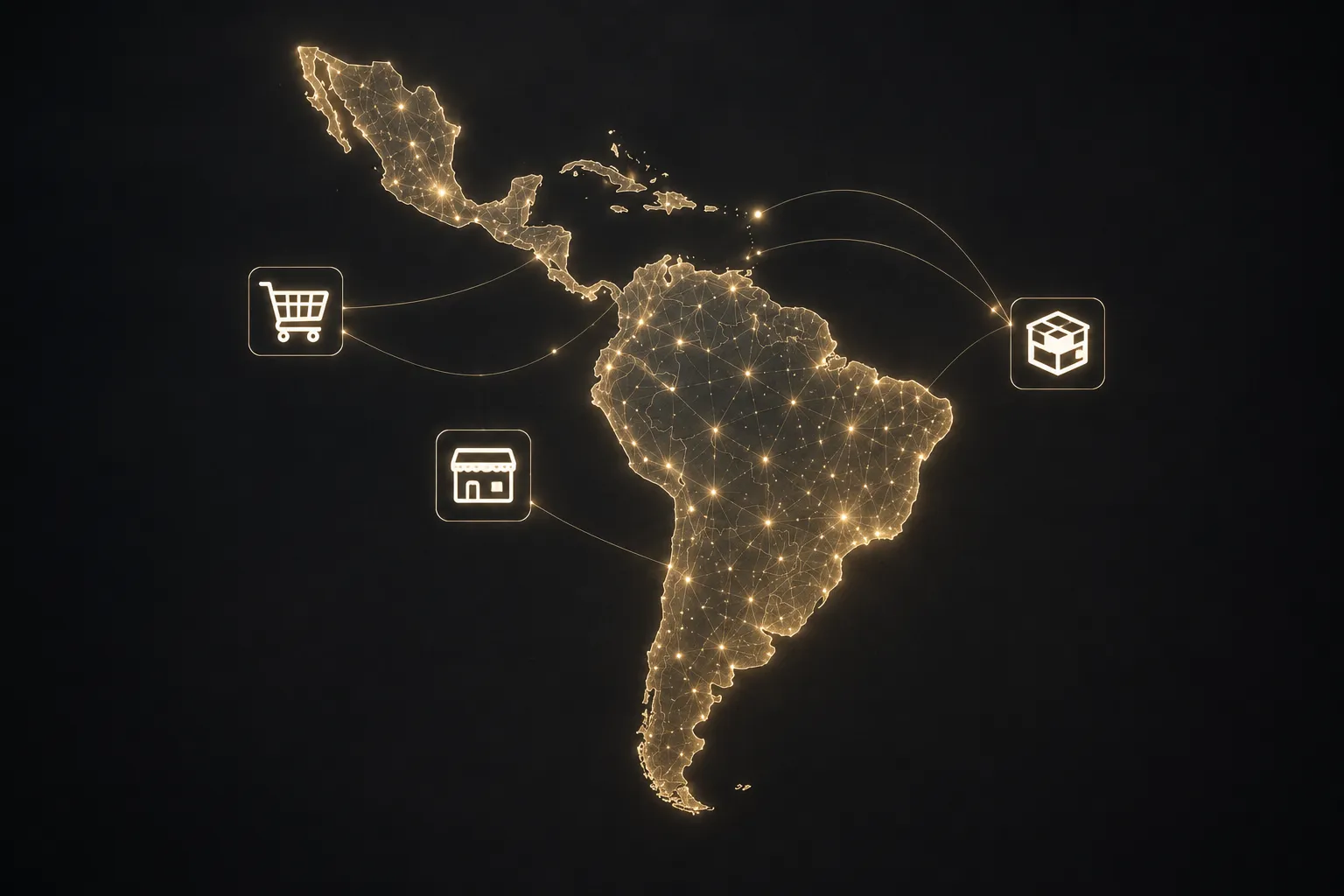
Latin America has the most dynamic and fragmented marketplace ecosystem in the world. While in the United States Amazon concentrates 40% of online sales and in China Alibaba dominates with a similar position, in LATAM the landscape is radically different: there are at least 25 relevant marketplaces spread across 6 main markets, with different leaders by country, by category and by consumer segment.
For a CPG brand, retailer or manufacturer looking to grow in the digital channel, this fragmentation is simultaneously an opportunity and a challenge. The opportunity: multiple channels to build presence without depending on a single player. The challenge: each channel has its own rules, algorithms, costs and consumer types. Choosing poorly which marketplaces to prioritize can spread resources thin and produce mediocre results everywhere.
This guide gives you the complete map to make that decision with confidence.
The LATAM marketplace ecosystem: a panoramic view
Before getting into the detail of each platform, it’s important to understand the structure of the ecosystem. LATAM marketplaces can be classified into four categories:
Generalist horizontals: They sell practically everything. They have the highest traffic and are where the consumer goes first when they have no channel preference. MercadoLibre and Amazon are the paradigmatic examples.
Specialized verticals: Focused on specific categories. They have smaller but more qualified audiences for their category. Examples: Despegar (travel), iFood/Rappi (food delivery and quick commerce), Linio in electronics.
Retailer marketplaces: Large physical retail chains that have opened their online platform as a marketplace, allowing third-party brands to sell alongside their own catalog. Examples: Falabella, Liverpool, El Corte Inglés, Walmart, Coppel, Costco Mexico.
Social commerce and emerging players: TikTok Shop, Instagram Shopping, WhatsApp Commerce. Still in early stages in LATAM but with explosive growth that can’t be ignored in medium-term strategic planning.
The 6 LATAM markets and their marketplace profile
Mexico: the most complex and competitive market
Mexico is the second-largest eCommerce market in LATAM (after Brazil) with projected sales of USD 43 billion by 2025. It’s also the most complex in terms of marketplace competition.
MercadoLibre Mexico: Still the undisputed leader with more than 60 million monthly unique visitors. Dominates electronics, home, tools and fashion. For mass consumption categories (food, personal care, home) it has grown significantly over the last two years. Average fee: 11-17% depending on category, plus advertising costs if Mercado Ads is used.
Amazon Mexico: With growing investment in its own logistics (Mexico City, Guadalajara, Monterrey), Amazon has accelerated strongly. For international brands or those already present on Amazon US, operating in Mexico is a natural next step. Strong in electronics, books, toys and health. Average fee: 8-15% depending on category, plus FBA if its fulfillment service is used.
Liverpool: The crown jewel of Mexican physical retail turned digital marketplace. Urban upper-middle class audience, excellent for fashion, home, consumer electronics and beauty. Sustained growth. Fee: 12-18% with room for negotiation for brands with volume.
Walmart Mexico / Coppel / Costco Mexico: All three have active marketplace platforms with very different audiences. Walmart reaches the value-conscious consumer; Coppel has unique penetration in popular segments (with its own credit system); Costco has high-purchasing-power audiences but lower visit frequency.
Rappi / JOKR / Uber Eats: For mass consumption categories (food, beverages, personal care, household hygiene), quick commerce is no longer a future trend: it’s a current channel that in Mexico City and Guadalajara represents a significant and growing percentage of CPG online sales.
Brazil: the giant with its own logic
Brazil is the largest eCommerce market in LATAM with more than USD 90 billion projected for 2025. But it’s also the most distinct from the rest of the region: it has its own payments ecosystem (PIX, boleto bancário), its own platforms (Mercado Livre leads here too, but with much more competition) and complex tax regulation (ICMS, COFINS) that makes operating there without local partners extremely difficult.
Mercado Livre: Absolute leader with more than 100 million monthly unique visitors. Its Mercado Envios service has nationwide coverage superior to any other logistics operator. For any brand that wants a presence in Brazil, Mercado Livre is not optional.
Shopee: Has had explosive growth in Brazil since entering in 2019. Particularly strong in electronics, fashion and lower-price categories. Its low-fee model (7-9% in many categories) makes it attractive to sellers with tight margins.
Amazon Brazil: Grew significantly but remains the third player, not the leader as in other global markets. Strong in books (historically its anchor in Brazil), electronics and third-party marketplace products.
Americanas / Submarino / Shoptime: Grupo Americanas (in restructuring after its 2023 bankruptcy) remains a relevant marketplace, though with a smaller role than before.
Colombia: the market with the highest relative growth
Colombia is the eCommerce market with the highest relative growth rate in LATAM, driven by an expanding middle class, high smartphone penetration and steady improvement in logistics infrastructure.
MercadoLibre Colombia: Clear leader with coverage in Bogotá, Medellín, Cali and growing presence in intermediate cities.
Falabella: With physical stores and a strong online presence, Falabella has an upper-middle class audience that values the reliability of an established retailer. Its strong categories are home, fashion and technology.
Rappi: Founded in Colombia, Rappi has extraordinary penetration in Bogotá and Medellín. For mass consumption brands, it’s the most relevant quick commerce channel in the market.
Alkosto / Éxito / Jumbo: Colombian retailers that have opened their platforms as marketplaces. Very different audiences: Alkosto in electronics and appliances, Éxito and Jumbo in supermarket goods.
Argentina: the market of volatility and opportunity
Argentina has one of the most active eCommerce markets in LATAM in terms of relative penetration (Argentines shop online at a high frequency), but economic instability, the exchange rate and currency controls mean operating there requires a specific strategy.
MercadoLibre Argentina: More dominant here than in any other market. Its integration with Mercado Pago (the preferred payment method) gives it a structural competitive advantage no competitor has been able to erode.
Frávega / Fravega.com: For electronics and appliances, Frávega has a relevant marketplace presence and a loyal audience.
Chile: the most mature and sophisticated market
Chile has the highest eCommerce per capita in LATAM and a more demanding consumer in terms of shopping experience, logistics and after-sales service.
Falabella Chile: The market leader with its falabella.com platform. For fashion, home and technology brands, being on Falabella Chile is not optional.
Ripley / Paris / Lider: All three have active marketplaces with different audiences. Ripley and Paris for middle-class fashion and home; Lider (Walmart Chile) for mass consumption and value.
MercadoLibre Chile: Second player with sustained growth, particularly strong in second-hand electronics and collectibles.
Fee comparison table by marketplace and category
This is the information most brands look for and that’s hardest to find consolidated. The following figures are estimates based on our operating experience and market data (exact fees vary by volume, negotiation and seller program):
| Marketplace | Country | Electronics | Fashion | Home | Food/CPG | Beauty |
|---|---|---|---|---|---|---|
| MercadoLibre | MX/CO/CL | 11-14% | 14-17% | 13-16% | 10-13% | 14-17% |
| Amazon | MX/BR | 8-10% | 15-17% | 12-15% | 8-10% | 12-15% |
| Falabella | CL/CO/PE | 12-15% | 15-18% | 13-16% | N/A | 15-18% |
| Liverpool | MX | 12-15% | 15-18% | 13-16% | N/A | 15-18% |
| Shopee | BR | 7-9% | 9-11% | 8-10% | 7-9% | 9-11% |
| Rappi | MX/CO/BR | N/A | N/A | N/A | 20-28%* | 20-28%* |
| Walmart MX | MX | 8-12% | 12-15% | 10-13% | 8-10% | 12-15% |
*Rappi and other quick commerce platforms have a higher fee model that’s offset by delivery speed as a conversion factor and the price premium consumers are willing to pay.
Important: On top of base fees, you need to add advertising costs (Mercado Ads, Amazon Ads, etc.) which in competitive operations can represent an additional 5-15% of revenue, plus logistics costs if the marketplace’s fulfillment service is used (MercadoFull, FBA, Falabella Fulfillment).
How to prioritize: the decision framework for choosing where to sell
With so many options, the question brands ask us most is: where do I start? Here’s the framework we use to help our clients make that decision:
Step 1: Define your eCommerce buyer persona with precision
It’s not “adults aged 25-45 who shop online.” It’s “women aged 28-40, ABC+ segment, in Mexico City and Guadalajara, who buy beauty and personal care products via mobile, mainly at night.” The more precise the profile, the clearer which platforms concentrate it.
Step 2: Analyze where your category is, not just overall traffic
A marketplace’s overall traffic matters less than the depth and activity of your specific category. Use tools like Nubimetrics (for MercadoLibre) or Jungle Scout (for Amazon) to analyze search volume and sales in your category before deciding priorities.
Step 3: Assess your fulfillment capacity by market
Every new marketplace requires logistics capacity. Can you guarantee competitive delivery times in that market? Do you have or can you access a reliable 3PL? Seller reputation on marketplaces depends critically on delivery speed and reliability. A new marketplace with unresolved logistics is a risk to your reputation.
Step 4: Calculate unit economics before entering
Before activating any marketplace, run the model: sale price - marketplace fee - estimated advertising cost - logistics cost - returns cost - operating cost = contribution margin. If that number is negative or unsustainably low, the marketplace isn’t viable at that price, or you need a higher sale price.
Step 5: Decide between breadth and depth
There are two valid strategies: being excellent in 2-3 marketplaces (depth) or having a basic presence in 8-10 (breadth). Brands just starting out in the digital channel should choose depth: it’s better to be a Top Seller on MercadoLibre than to have a mediocre presence on 10 platforms.
The recommended expansion sequence for CPG brands in LATAM
Based on our experience working with more than 100 mass consumption brands in the region, this is the expansion sequence that produces the best results:
Stage 1 - The core (months 1-6): MercadoLibre in your main market + Amazon if your category has a strong presence there. Total focus on optimization: high-quality content, active reputation management, well-structured Mercado Ads campaigns, reliable logistics.
Stage 2 - The anchor retailer (months 4-9): A reference retailer in your market (Liverpool in Mexico, Falabella in Chile/Colombia). These channels validate your brand with a more demanding consumer segment and generate a positive halo in your overall perception.
Stage 3 - Quick commerce (months 6-12): If your category is frequent-consumption (food, beverages, personal care, hygiene), activating Rappi, JOKR or the local equivalents becomes a priority. This channel has tighter margins but captures a different, incremental purchasing behavior.
Stage 4 - Geographic expansion (month 9+): With the model proven in your main market, expand to secondary markets using the same playbook but adapted to local specifics.
The trends that will transform the map over the next 24 months
TikTok Shop in LATAM: After its successes in Asia and its launch in the United States and Mexico, TikTok Shop will change the equation of product discovery. Social commerce, where content and purchase happen on the same platform, is the most disruptive short-term trend.
Quick commerce consolidation: Rappi, JOKR, Uber Eats and supermarket dark stores are going to keep stealing share from traditional marketplaces in frequent-consumption categories. CPG brands that aren’t building their quick commerce strategy are already running behind.
The rise of retail media: MercadoLibre, Amazon, Falabella and others are building retail media networks that will become as important an advertising channel as Meta and Google for CPG brands. Marketplaces’ first-party data on real purchasing behavior makes them the most relevant medium for performance advertising.
Amazon’s logistics expansion in LATAM: Amazon is investing aggressively in logistics infrastructure in Mexico, Brazil and Colombia. As its coverage and delivery speeds improve, its market share will grow at the expense of local players.
Conclusion: the map matters, but execution matters more
Understanding the LATAM marketplace ecosystem is the first step. But the difference between brands that grow in the digital channel and those that stagnate isn’t being on the right marketplace — it’s executing well on the marketplace they chose.
That execution has technical components (optimized content, data integration, inventory management), commercial components (competitive pricing, reputation management, advertising strategy) and operational components (reliable logistics, responsive customer service, returns management).
Brands that dominate eCommerce in LATAM don’t have a magic channel secret. They have an excellent operation on the channels they chose to prioritize.
Which marketplaces does your brand currently operate on? Which ones are you evaluating adding in 2025? Tell us in the comments — we’re very interested in hearing the realities of different categories and markets. If you want to run a diagnosis of your marketplace strategy and channel prioritization, we’re available.
By Matías Poso, CEO at Balloon Group a Fastforward AI Company.